Euro 2012 Qualifiers Robin van Persie score four, Wesley Sneijder and Klaas Jan Huntelaar score two each as Netherlands beat San Marino 11-0 in Group E.
Video highlight of all goals as Netherlands beat San Marino
Showing posts with label Netherlands. Show all posts
Showing posts with label Netherlands. Show all posts
Saturday, September 3, 2011
Euro 2012 Qualifiers: Robin van Persie score four, Wesley Sneijder and Klaas Jan Huntelaar score two each as Netherlands beat San Marino 11-0 in Group E
Euro 2012 Qualifiers Robin van Persie score four, Wesley Sneijder and Klaas Jan Huntelaar score two each as Netherlands beat San Marino 11-0 in Group E.
Video highlight of all goals as Netherlands beat San Marino
Video highlight of all goals as Netherlands beat San Marino

Sunday, April 10, 2011
Lavans Stadion (Stadion De Braak) (Helmond Sport v FC Emmen)
 Last weekend I was in the Netherlands for a short football trip. The 'main event' was going to be Willem II v Roda JC (report to follow soon!) on the Saturday but I had decided to also see a match in the Jupiler League, the second tier in Dutch football. The Jupiler League teams all play their games on Friday nights. I usually stay at my parents' in the town of Heerlen when I am over and this somewhat limits the teams I can see as I usually travel by train and Heerlen is tucked away in a southeastern corner of the Netherlands, near the Belgian and German borders. This means I cannot go to grounds that are too far away because I would not be able to catch a train back, which basically rules out clubs like Veendam, Go Ahead Eagles, Cambuur and AGOVV. Helmond, near Eindhoven, is one of the towns with a representative in the Jupiler League that are near enough to travel back and forth to on a Friday night.
A return ticket from Heerlen to Helmond cost me €32, which I thought was quite dear for a journey roughly the equivalent of Glasgow-Edinburgh. After an hour I arrived at Eindhoven station where I had to change and after a 10-minute journey I got off at Helmond. The walk to the stadium took me about 25 minutes. Helmond Sport's home ground used to be called 'De Braak' but was renamed 'Lavans Stadion' last year for sponsorship reasons. Upon arrival at the ground I took a few pictures and bought my ticket for the North Stand, which only set me back €9.50. There was a healthy crowd of well over 3,000 inside the 4,100-capacity stadium but the atmosphere was quite subdued as is the norm in this league. Nevertheless the lads on the North Stand were putting in a good effort now and then.
Helmond Sport are one of these quintessential Jupiler League teams. I could not remember them ever playing in the Eredivisie but, according to Wikipedia, they had a short spell in the top tier during the 1982/83 and 1983/84 seasons. Helmond have been reasonably successful so far this season, sitting in third place, and a place in the promotion play-offs looks as good as certain. Tonight's opponents Emmen have never played at the highest level. They only started playing professional football in 1985 but were close to promotion a few times in the late nineties and early noughties. The last few seasons, including the present one, have been rather disappointing for the Emmen fans.
Presumably the Helmond fans had expected a win tonight but it was not to be. Eldridge Rojer scored the opening goal for Emmen in the sixteenth minute. Marc Höcher equalised fifteen minutes later and the half-time score of 1-1 seemed fair. In the second half Helmond upped the ante but were unable to find the net until Ilja van Leerdam scored 2-1 minutes before time. Since Emmen player Jeffrey de Visscher had received a second booking five minutes previously the three points seemed to be in the bag for Helmond. Emmen were not giving up however and Randy Wolters stunned Helmond four minutes before time with the equaliser. I have to say goalie Wouter van der Steen, who replaced the injured Robert van Westerop, looked suspect for both goals.
After an entertaining game I made my way back to the train station an was back at my parents' before midnight.
 The Noordtribune or North Stand was built in 2000.
 The Oosttribune or East Stand.
 The Westtribune or West Stand.
 Again the Noordtribune.
 The Oosttribune.
 The Emmen fans can be seen in the faraway corner. The lads on the pitch were taking part in some competition where they had to shoot a crate off the crossbar in two attempts. I think three of them actually managed to do so, I have no idea what the prize was.
 Both teams entering the pitch.
 There is no stand in the southern end of the ground. There used to be terraces but these were demolished in the 1990s.
 The Noordtribune seen from my seat.
 This injury-time free-kick did not go in and the night ended disappointingly for Helmond.
Friday 1st April 2011
Jupiler League
Helmond Sport 2 FC Emmen 2
Helmond: Höcher 30, Van Leerdam 82.
Emmen: Rojer 16, Wolters 86.
Att: 3,117
Wednesday, April 6, 2011
Haarlem-stadion (HFC Haarlem)
 Last weekend I was in the Netherlands again. Apart from seeing my family, my main purpose of this trip was the Willem II v Roda JC game on Saturday. After having arrived at Schiphol Airport my first stop was the city of Haarlem, where I had planned to visit Haarlem-stadion, the former home of HFC Haarlem. Haarlem, founded in 1889, played their final match on 22nd January 2010, a 3-0 defeat by Excelsior at Stadion Woudestein in Rotterdam. Three days later the club were declared bankrupt. The stadium is a twenty-minute walk from Bloemendaal train station. Unfortunately it was absolutely pouring and I arrived at the ground soaking wet. I was delighted the gate to the stadium was open but because of the horrendous weather I did not take as many pictures as I would have done on a sunny day.
Haarlemsche Football Club Haarlem won the Dutch Cup twice, in 1902 and 1912. In 1946, before the introduction of professional football in the Netherlands, they were crowned champions of the Netherlands. After the start of the professional era in the 1950s Haarlem played a rather meaningless part. Their relative heydays were the 1970s and 1980s during which Haarlem played mostly in the Eredivisie, the Dutch top flight, and even managed, with a squad that included a 19-year-old Ruud Gullit, to finish in fourth place in 1982. This meant qualification for the UEFA Cup. Belgian side AA Gent were eliminated in the first round and the opponents in the second round were Spartak Moscow. Although Spartak won both legs, the events on the pitch were, although only in hindsight, overshadowed by what happened in the stands of Spartak's ground, the Lenin Stadium (now Luzhniki Stadium).
The Luzhniki Disaster was a human stampede in which, according to the official statistics, 67 Russian fans were killed. Many estimates of the actual death count are much higher however, some estimate as many as 340 were killed in this stadium disaster. The Soviet authorities tried to keep a lid on the tragedy and it was not until much later, after Gorbachev had become leader of the Soviet Union, that it was talked about openly in the Russian press. Initially the authorities, as was often the case and not just in the Soviet Union, blamed the football fans for the disaster. It was not until much later that a completely different picture was painted. Some Spartak fans were throwing snow balls at policemen who were stationed inside the ground. The large football crowd acted as a relatively secure cloak of anonymity and provided some people with a rare chance to have a bit of fun at the expense of the authorities. The police were not amused however and after the game they closed off several exits to make it easier to find the culprits on their way out. Not surprisingly the police were never held responsible for the tragedy. The stadium manager, who had only been in the job for a couple of months, was made a scapegoat and spent 18 months in a labour camp. The Haarlem players who played in Moscow only found out about the disaster years later.
In 1984 Haarlem ended the season in fourth place once more although this time fourth place did not mean qualification for Europe. In 1990 the Roodbroeken ('Red Shorts') were relegated to the First Division from which they never managed to escape. Even though they even finished bottom of this league a few times, relegation from the Dutch First Division was not possible at the time, a set-up followers of the Scottish Third Division will be familiar with. It was decided that from the 2009/10 season two First Division teams would be relegated to the newly formed Topklasse and Haarlem were 'favourites' to be one of the first two clubs in almost forty years to make the drop from the second tier in Dutch football. Instead they became the first club to disappear from Dutch professional football altogether since both FC Wageningen and VCV Zeeland folded in 1992.
Only months after the demise of the club amateur side Nieuwe Haarlemsche Football Club Haarlem was founded. They merged shortly after with HFC Kennemerland. Haarlem-Kennemerland, who now call Haarlem-stadion their home ground, currently play in the Tweede Klasse, the sixth tier in the Dutch league pyramid.
 The overgrown terrace in the east end of the ground had already been closed for a while.
 The Kick Smit Tribune. Kick Smit (1911-1974) was a Haarlem player who was capped 29 times and scored 26 goals for the Netherlands. He represented the country at the 1934 and 1938 World Cup finals.
 The Noordtribune or North Stand.
 Again the East Terrace.
Friday, October 8, 2010
Gemeentelijk Sportpark Kaalheide (Roda JC)
 I was visiting my parents in the Netherlands last weekend and decided to take some pictures of Gemeentelijk Sportpark (=Municipal Sports Ground) Kaalheide. Fortunately the gate was open and I could walk into the ground without any problems.
Gemeentelijk Sportpark Kaalheide was opened in 1950 and was Roda JC's home ground until 2000 when the Pride of the South moved to the 19,600 capacity all-seater Parkstad Limburg Stadion. It is situated in the town of Kerkrade, a small town in the most southern part of the Netherlands near the German border, only 6 miles from the German city of Aachen.
Roda JC were only founded in 1962, the result of the merger of Roda Sport and Rapid JC. In 1973 Roda JC were promoted to the Dutch top flight, the Eredivisie, and they have never been relegated since, although it took a penalty shoot-out win in the play-off finals at Cambuur Leeuwarden in 2009 to secure a slot in the Eredivisie for last season.
I started visiting Kaalheide during the 1994/95 season. Roda were at their best at that time. They only lost two league games in the whole season and finished the season in runner-up spot behind European champions Ajax. For the 1995/96 season I bought my first season ticket and I remained a season ticket holder until I moved to Scotland in 2001.
Kaalheide was built as a multi-functional stadium and was (and still is) used as an athletics venue as well. This was a common concept in the Netherlands, and the rest of the continent for that matter. The running track around the pitch ensured that the terraces behind the goals were a fair distance from the pitch and this, combined with the fact that these terraces were uncovered, contributed to a widespread dislike of them by both home and away supporters. Luckily the home supporters had an alternative.
 The picture above was taken in either November or December 1998 from the North Terrace, a roofed terrace where the more fanatical supporters used to congregate. It looks like Roda won and my guess is that this was the derby against MVV of Maastricht on 27th November 1998 (2-1). The Main Stand, which was renovated as late as 1992 can be seen in the background. The two ends behind the goals were not covered and these terraces were generally not very popular. Away supporters were allocated one half of the West Terrace until the late nineties. Later the away fans were moved to the East Terrace to make it easier to segregate the opposing supporters' groups outside the ground.
The official capacity changed over the years and was considered to be around 15-16,000 in the late nineties however sell-outs have always been rare at Kaalheide. A record crowd of 23,000 saw Roda JC lose to Anderlecht (2-3) in the second leg of the first round of the UEFA Cup on 26 September 1976 (3-5 aggregate). This is still a record for a Roda home game.
Unlike many other older stadiums in the Netherlands Kaalheide is still in use, both as an athletics venue and as a football ground: it is Roda's training ground and the reserve team play their games at Kaalheide. The North Stand was however demolished in 2005 because it had fallen into disrepair and was in danger of collapsing.
 The Main Stand was renovated as recently as 1992.
 The West Terrace.
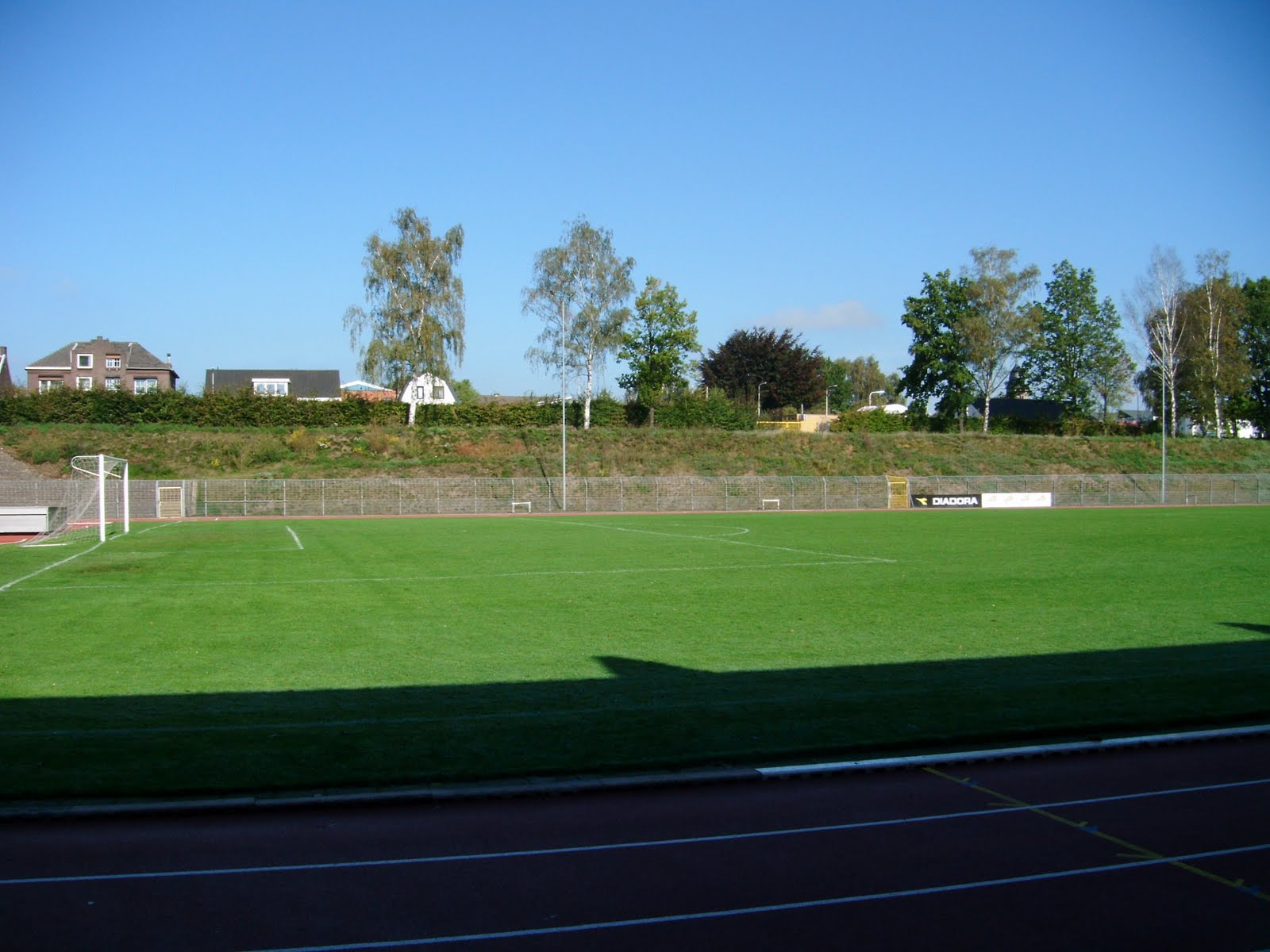 The roofed terrace which ran along the nothern side of the pitch was demolished in 2005.
 The East Terrace.
 Again the uncovered West Terrace.
 The grass bank that replaced the old North Terrace.
 The Main Stand seen from the West Terrace.
 The Main Stand.
 These two pictures I took when Roda were still playing at Kaalheide around 1999 or 2000...
 ...I cannot remember the occasion!
Gemeentelijk Sportpark Kaalheide (Roda JC)
I was visiting my parents in the Netherlands last weekend and decided to take some pictures of Gemeentelijk Sportpark (=Municipal Sports Ground) Kaalheide. Fortunately the gate was open and I could walk into the ground without any problems.Gemeentelijk Sportpark Kaalheide was opened in 1950 and was Roda JC's home ground until 2000 when the Pride of the South moved to the 19,600 capacity all-seater Parkstad Limburg Stadion. It is situated in the town of Kerkrade, a small town in the most southern part of the Netherlands near the German border, only 6 miles from the German city of Aachen.
Roda JC were only founded in 1962, the result of the merger of Roda Sport and Rapid JC. In 1973 Roda JC were promoted to the Dutch top flight, the Eredivisie, and they have never been relegated since, although it took a penalty shoot-out win in the play-off finals at Cambuur Leeuwarden in 2009 to secure a slot in the Eredivisie for last season.
I started visiting Kaalheide during the 1994/95 season. Roda were at their best at that time. They only lost two league games in the whole season and finished the season in runner-up spot behind European champions Ajax. For the 1995/96 season I bought my first season ticket and I remained a season ticket holder until I moved to Scotland in 2001.
Kaalheide was built as a multi-functional stadium and was (and still is) used as an athletics venue as well. This was a common concept in the Netherlands, and the rest of the continent for that matter. The running track around the pitch ensured that the terraces behind the goals were a fair distance from the pitch and this, combined with the fact that these terraces were uncovered, contributed to a widespread dislike of them by both home and away supporters. Luckily the home supporters had an alternative.
The picture above was taken in either November or December 1998 from the North Terrace, a roofed terrace where the more fanatical supporters used to congregate. It looks like Roda won and my guess is that this was the derby against MVV of Maastricht on 27th November 1998 (2-1). The Main Stand, which was renovated as late as 1992 can be seen in the background. The two ends behind the goals were not covered and these terraces were generally not very popular. Away supporters were allocated one half of the West Terrace until the late nineties. Later the away fans were moved to the East Terrace to make it easier to segregate the opposing supporters' groups outside the ground.The official capacity changed over the years and was considered to be around 15-16,000 in the late nineties however sell-outs have always been rare at Kaalheide. A record crowd of 23,000 saw Roda JC lose to Anderlecht (2-3) in the second leg of the first round of the UEFA Cup on 26 September 1976 (3-5 aggregate). This is still a record for a Roda home game.
Unlike many other older stadiums in the Netherlands Kaalheide is still in use, both as an athletics venue and as a football ground: it is Roda's training ground and the reserve team play their games at Kaalheide. The North Stand was however demolished in 2005 because it had fallen into disrepair and was in danger of collapsing.
The Main Stand was renovated as recently as 1992.The West Terrace.The roofed terrace which ran along the nothern side of the pitch was demolished in 2005.The East Terrace.Again the uncovered West Terrace.The grass bank that replaced the old North Terrace.The Main Stand seen from the West Terrace.The Main Stand.These two pictures I took when Roda were still playing at Kaalheide around 1999 or 2000......I cannot remember the occasion!
Stadion Woudestein (Excelsior v Roda JC)

Whilst visiting the Netherlands I saw my first game at Stadion Woudestein last Saturday. I went as an away fan as my team Roda JC were playing Excelsior, currently two points ahead of 'big brother' Feyenoord and with Sparta plying their trade in the Jupiler League they currently are the highest ranked team in Rotterdam. Still, they are the least popular of the three professional sides in Holland's second largest city. Woudestein has a capacity of only 3,500, making it by far the smallest stadium in the Dutch top flight. Despite its small capacity the ground was not sold out last Saturday with only 3,214 in attendance despite the club's promising start to the season, including a 3-2 defeat of Feyenoord. Predicted by many as 'certs' for relegation they are currently lying twelfth in the 18-team Eredivisie.
Excelsior do not have a fan base that justifies their place in the Eredivisie. Founded in 1902 they are one of the older professional sides in the Netherlands. Although Excelsior and Feyenoord had cooperated for many years their partnership became official in 1996 when Excelsior became a feeder club for Feyenoord. Feyenoord stalled young and talented players at the Woudestein club to give them valuable playing minutes in the Dutch second tier. Although the agreement between the two Rotterdam clubs was controversial amongst many supporters the club were promoted to the Eredivisie in 2002. They were relegated again the following season but were promoted once more in 2006. This time their stay in the top league lasted two seasons and Feyenoord ended the partnership in 2008. However only five months later the two Rotterdam clubs agreed on an even more extensive partnership and Excelsior were promoted to the top tier once more last season.
This was my first Roda JC league game in almost four years I am ashamed to admit but I had been looking forward to this one for a while. Roda have started this season extremely well; they have not been playing glorious football on a weekly basis but they have kept on grinding out results, just like last Saturday. The team from Kerkrade were the dominant side in the first half but Wouter Gudde opened the score for Excelsior after some shambolic Roda defending. Pa-Modou Kah equalised early in the second half and a draw looked like a fair result. However Anouar Adouir sealed another win for Roda in the 88th minute to the delight of the travelling fans.
I made the journey to Woudestein on a supporters bus, which is my preferred method of travel to away games in the Netherlands because it is cheap (€30 for non-members including match ticket) and relatively comfortable and the atmosphere is always top-notch. The bus left from the Roda ground in Kerkrade at around 5pm. After journey of just over three hours we arrived at Stadion Woudestein. As mentioned above, the stadium is very small but I was pleasantly surprised to see terracing in the away end. The journey back to Kerkrade went slightly quicker and I arrived back at my parents’ house on Sunday morning just after 2am.
 The not so impressive entrance to the away stand.
 Nice tea hut...
 I was pleasantly surprised to see these terraces in the away end.
 The Zuidtribune or South Stand.
 The I.J.B. Albers Tribune.
 The main stand is called the Henk Zon Tribune.
 Celebrations after Kah's equaliser.
 Roda kept on searching for the winning goal which finally came in the 88th minute.
 'Get off that fence you naughty boy!'
 Roda players celebrating...
 ...after another victory!
Saturday 2nd October 2010
Eredivisie
Excelsior 1 Roda JC 2
Excelsior: Gudde 38.
Roda JC: Kah 69. Hadouir 88.
Att: 3,214
Subscribe to:
Posts (Atom)


 |
 |
 |
 |
 |
 |
 |
 |
 |
 |
 |
 |
 |
 |
 |